Startups in Estonia: how to launch, grow, and scale from a digital-first business base

This article is updated to May 2026 and reflects the latest available information on startups in Estonia at the time of writing. As the startup market, funding environment, and regulatory framework can develop over time, it is always worth checking the most recent official guidance before making business decisions.
Startups in Estonia keep attracting founders because the country combines fast online company formation, EU market access, and a business culture that expects companies to think internationally from the start. Based on the latest available official and ecosystem data, Estonia has more than 1,500 startups, over 1,300 economically active startup companies, and more than 15,000 people working in active startups. The setup side is also unusually efficient. So most companies are established online, and private limited companies can often be registered very quickly.
For founders, that makes Estonia appealing for a simple reason. It is not only easy to register a business here. It is also easier to build a startup structure that can support remote management, international sales, and future investment. At Silva Hunt, an Estonia-based accountancy and tax advisory firm, we usually see the best results when founders treat registration as only the first step and plan banking, compliance, accounting, and tax position from the beginning.
Why startups in Estonia stand out
Estonia’s startup scene did not grow by accident. Startup Estonia describes the country as a tight ecosystem where founders, investors, operators, and support organizations interact closely. While several ecosystem voices stress that Estonia’s small home market pushes companies to become global from day one. That global-first mindset helps explain why the country has produced an outsized number of well-known technology companies for its size.
The numbers also show that this is not only a branding story. The latest half-year startup sector report counted 1,566 startups in Estonia, of which 1,321 were economically active. Those active companies employed 15,011 people according to EMTA, and 17,082 people according to the Department of Statistics l. The latest full-year overview reported record startup turnover of EUR 3.902 billion. Employment tax contributions of EUR 366.9 million, and an average gross monthly salary of EUR 3,650 in the startup sector.
Another reason startups in Estonia attract international founders is that the digital state reduces friction. Invest in Estonia states that 98% of companies are established online, while official e-Residency guidance explains that company registration can be completed fully online by founders with supported digital identity tools. That combination matters for international teams that want speed without losing legal clarity.

Steps to launch a startup in Estonia
Opening a startup in Estonia is usually straightforward, but doing it properly still requires a sequence. The legal act of registration is fast. The practical work around structure, banking, taxation and management – is what determines whether the company stays easy to run later.
1. Define the business model and founder structure
Before registration, decide what you are actually building, who owns what, and how the company will operate. Estonia is efficient, but investors and banks still expect a real business model, founder roles, and a clear cap table. This matters even more if you plan to apply for a Startup Visa. Because Startup Estonia says the business should be technology-based, innovative, scalable, and already have an MVP and first traction.
2. Choose the right legal form
For most startup founders, the usual choice is the private limited company, or OÜ. Invest in Estonia identifies the OÜ as Estonia’s most common business form. e-Residency guidance describes it as the most common entity for both Estonian residents and e-residents. It is typically the natural fit for an early-stage startup because it is flexible, familiar to service providers, and suitable for future growth.
3. Arrange digital access, legal address, and contact person
If the board is not based in Estonia, founders usually need a legal address or contact person service from a licensed provider. Official e-Residency guidance puts this service typically in the EUR 200 to EUR 400 yearly range. Notes that it is an administrative requirement, not a management right. This is where many remote founders benefit from using a local service firm from the start.
4. Register the company in the e-Business Register
The e-Business Register is Estonia’s official company portal. Official guidance explains that the portal is used to register companies, file applications, and submit annual reports. The e-Residency start-a-company guide states that company registration can be done online, with a state fee of EUR 265. The process can take from about 15 minutes to 1 hour once the founder has the required digital tools ready.
5. Make the share capital contribution
An OÜ no longer needs a large starting capital. e-Residency guidance states that the minimum share capital can be as little as EUR 0.01 per shareholder. But that the contribution must be confirmed during registration. That makes entry easy, but founders should still choose a realistic capital level for how the business will operate in practice.
6. Open the business account and set up administration
Official e-Residency guidance says founders commonly open a business account with a bank or fintech in the European Economic Area. It`s often online, and that accounting and tax support should be part of the setup discussion rather than an afterthought. It also reminds founders that e-Residency does not determine personal tax residency, which is an important point for cross-border startup teams.
7. Check licences, tax position, and substance
Not every startup needs a licence, but some sectors do. Estonia’s official startup and company guidance also makes clear that founders must think beyond registration. And ask where the company is managed, where taxes may arise, and what reporting duties apply. At Silva Hunt, this is usually where we add the most value, because founders often underestimate how much easier growth becomes when compliance is built in early.
8. Use the Startup Visa route when relevant
For non-EU founders, Estonia offers a Startup Visa route. Startup Estonia explains that this route is meant for innovative, scalable startups and also makes it easier for Estonian startups to hire non-EU talent. For the right company, that can be a major advantage when building an international founding team or specialist workforce.
Free consultation
Launch and manage your Estonian company fully online
From incorporation and legal address to accounting software, VAT reporting, and annual statements, Silva Hunt helps e-Residents run an Estonian company with a single reliable partner.
Short stories behind the best-known Estonian startups
The best way to understand startups in Estonia is to look at the companies that shaped the ecosystem.
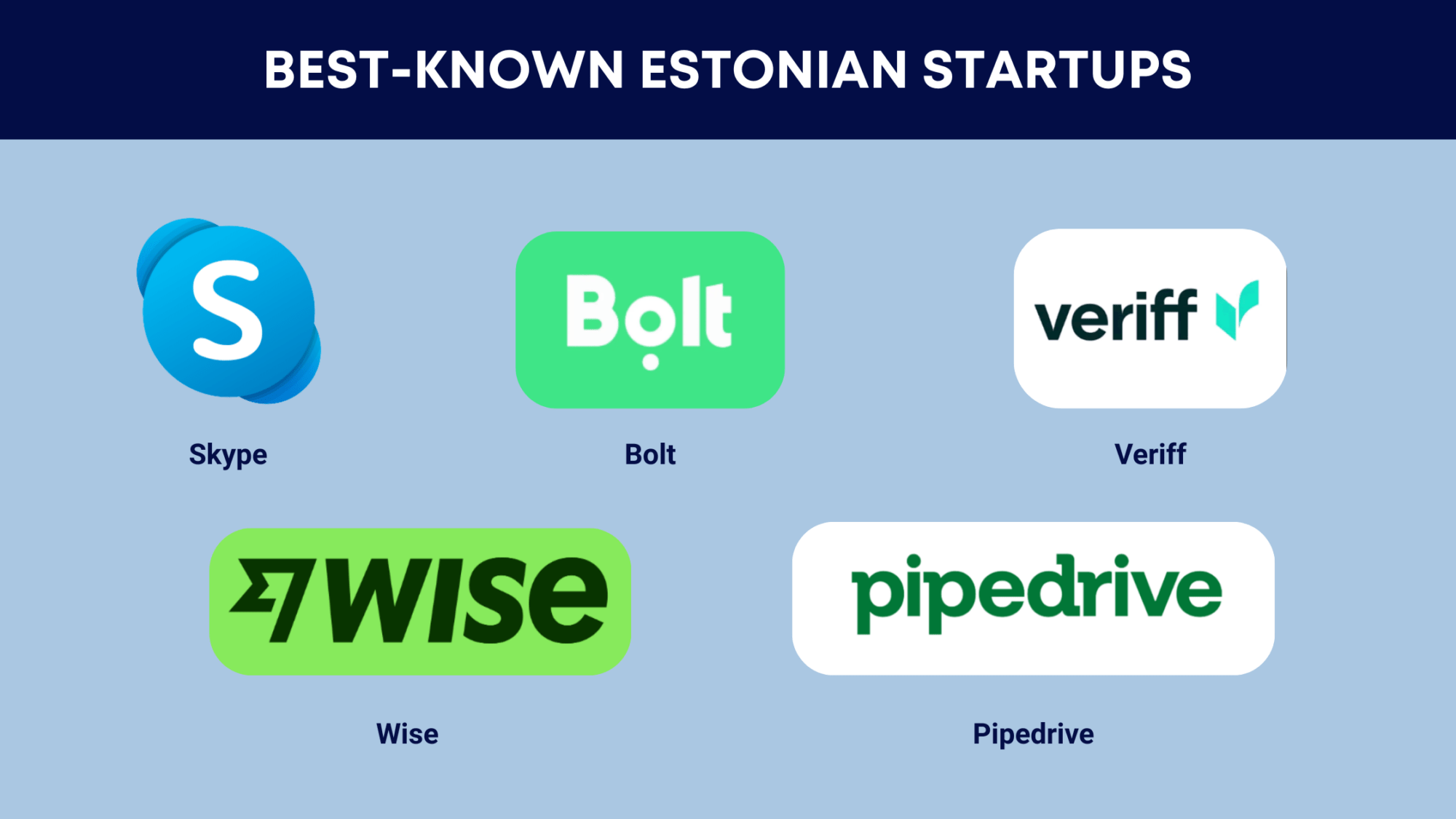
Skype helped change Estonia’s reputation from a small digital country into a serious technology base. Invest in Estonia describes Skype as one of the pivotal chapters in Estonia’s digitalization story, and its success created a generation of operators, founders, and investors who later helped other companies grow.
Wise grew by fixing a simple but painful problem: hidden costs in international money transfers. Its growth story is important because it showed that an Estonian-founded company could take a global financial problem, solve it clearly, and build a trusted international brand around that solution.
Bolt started from a local transport frustration and turned it into a mobility platform with international reach. Invest in Estonia recounts how the early idea came from the poor taxi-booking experience in Tallinn and how that problem evolved into one of Europe’s biggest technology companies.
Pipedrive succeeded because it was built by people who understood selling, not just software. Its founders focused on making CRM tools usable for real sales teams, and its story also reflects the wider “Skype alumni” effect that has influenced many later startups in Estonia.
Veriff represents a newer wave of Estonian startups built around digital trust. Its identity verification model fits perfectly with Estonia’s broader strengths in digital services, fintech infrastructure, and secure online business.
How startups in Estonia have grown
The growth story is not only about unicorns. It is visible in turnover, taxes, employment, and sector depth.
The latest full-year official overview reported record startup turnover of EUR 3.902 billion. It also showed that startup companies paid EUR 366.9 million in employment taxes and employed 14,396 people locally by the end of that period. That means startups in Estonia are no longer only early-stage experiments. They are a real part of the country’s economic base.
The sector has also become more international and more skilled. The same official overview says 31% of startup employees have foreign citizenship, 67% hold bachelor’s, master’s, or doctoral degrees, and 50% of the workforce consists of top specialists. For founders, that matters because it shows Estonia is not only founder-friendly. It is also a place where specialized teams can be built.
At the same time, the ecosystem is becoming more mature and selective. Startup Estonia’s latest half-year report says the number of new registrations has been declining since earlier peak years, while revenue per employee is rising sharply. In practical terms, that points to a market that is moving away from growth at any cost and toward stronger operating discipline.
What founders should expect from startups in Estonia over the next few years
The next phase for startups in Estonia looks likely to be more specialized, more science-based, and more capital-aware.
Deep tech is a major part of that picture. Recent official ecosystem reporting says deep tech companies generated EUR 325 million in revenue, paid EUR 112 million in taxes, and employed 3,395 people, while health technology, energy, and defense or security are among the strongest segments. Another official announcement says Estonia has launched a EUR 12.6 million programs to help create 37 internationally competitive research-intensive companies over the next four years.
AI, defense, and leaner SaaS also look set to stay important. Invest in Estonia’s startup awards summary highlighted AI as a comeback engine, defense tech as a growing European focal point. A SaaS as returning in a leaner, more sustainable form. That does not mean every startup will fit those categories. But it does suggest where investor attention and ecosystem energy are concentrating.
The main constraint is likely to be scale capital. Startup Estonia reported in March that growth companies across the Baltics and Nordics need better access to large-scale growth and infrastructure capital, especially in deep tech. That is important for founders to understand: Estonia is a very strong launch platform. But later-stage scaling may still require broader regional or international capital networks.
Overall, expectation is positive. Estonia still offers one of Europe’s cleanest startup setups, its ecosystem keeps producing serious companies. The official support is moving more visibly toward deep tech, applied research, energy, and globally scalable software. Founders who enter the market with a real business model and a clean compliance structure should find strong reasons to build here.