A1 Certificate tax implications: practical EU payroll and tax guide for employers and founders

Within the European Union, employees and entrepreneurs who temporarily work outside their “home” country can obtain an A1 certificate. This document confirms which national social-security system applies. It helps ensure you are subject to only one EU/EEA social-security regime at a time, reducing the risk of double social contributions.
This guide explains the day-to-day A1 Certificate tax implications in a way that is useful for companies, directors, and remote founders:
– how the A1 affects social taxes and payroll, what it does not solve (income tax),
– how to think about permanent establishment risk and different payment types (salary, dividends, directors’ fees, service fees, and allowances).
What an A1 certificate actually proves for social security
An A1 certificate establishes that the worker remains subject to the social-security system of the A1-issuing country while temporarily working in another EU/EEA state. While the certificate is valid for the covered activity:
- The employer continues paying social contributions in the A1-issuing country (for example, an Estonian employer would continue applying Estonian rules such as Estonian social tax).
- The worker continues to accrue the social benefits tied to that system (such as public health coverage and state pension pillar I, where applicable).
- The host country should accept the A1 as evidence that its social-security legislation does not apply to that same employment for that period.
A critical nuance for A1 Certificate tax implications is that the A1 is activity-specific. If the individual at ones performs separate employment or business activity in the host country (or another country), the A1 for one role does not automatically remove social-security exposure for the other role.
A1 Certificate tax implications for income tax: what the A1 does not cover
The A1 certificate is about social security, not income tax. Even with a valid A1, income tax may still be due in the country where the work is physically carried out. Whether and when the host country may tax depends on:
- The applicable double tax treaty (DTT) between home and host country
- The length of physical presence (often tested against treaty thresholds such as the 183-day concept)
- Whether the host country considers a local entity or market to be the “economic employer” in substance
In practice, shorter assignments often remain taxable only in the home country. But longer stays or certain working arrangements can shift taxing rights to the host country. This is why employers should treat A1 Certificate tax implications as a two-track exercise:
Social Security alignment (A1) and income tax and payroll compliance (treaty + local rules).
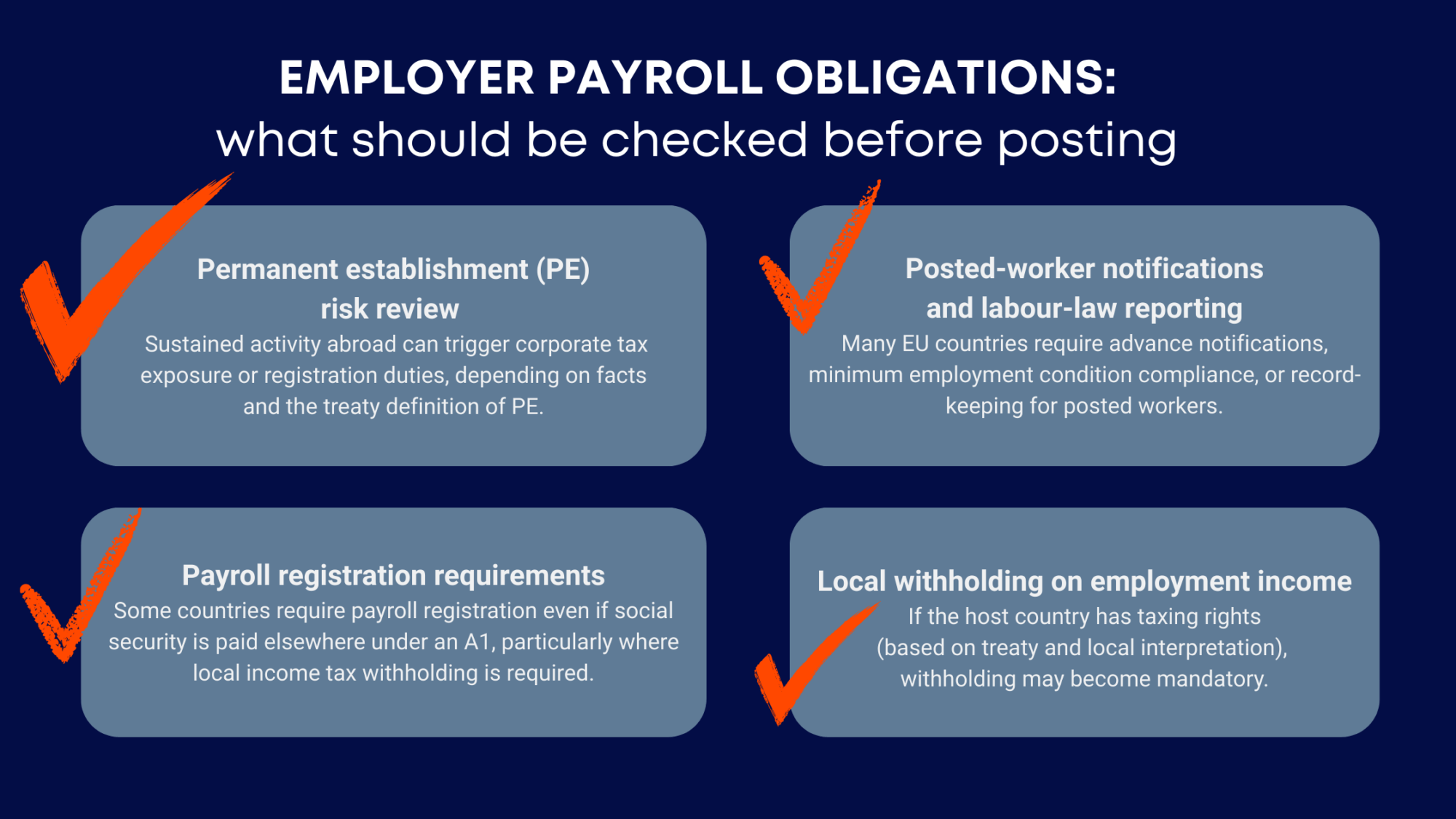
Employer payroll obligations: what should be checked before posting
Even when the A1 is in place, employers should assess whether they must take steps in the host country. A basic compliance checklist usually includes:
- Permanent establishment (PE) risk review
Sustained activity abroad can trigger corporate tax exposure or registration duties, depending on facts and the treaty definition of PE.
- Payroll registration requirements
Some countries require payroll registration even if social security is paid elsewhere under an A1, particularly where local income tax withholding is required.
- Local withholding on employment income
If the host country has taxing rights (based on treaty and local interpretation), withholding may become mandatory.
- Posted-worker notifications and labour-law reporting
Many EU countries require advance notifications, minimum employment condition compliance, or record-keeping for posted workers.
Managing these points proactively reduces the risk of surprise tax bills, penalties, or forced registrations.
Validity period: how long an A1 can apply and why extensions matter
For posted workers, A1 certificates are commonly issued for up to 24 months, with possible extensions under specific conditions and (often) coordination between the involved authorities.
From an employer’s perspective, the key “real-life” issue is continuity: if the posting quietly becomes long-term, the A1 timeline and the individual’s actual facts on the ground can diverge. That divergence is where disputes tend to arise – especially when audits examine where the work was really carried out and for how long.
Daily allowances and per diems: where social security ends but tax questions begin
Daily allowances (päevaraha) and per diems are a frequent grey zone. In Estonia, foreign business travel allowances can be tax-exempt up to statutory limits under Estonian rules. However, the host country may treat allowances differently:
- Some jurisdictions tax per diems fully as employment income
- Others allow partial exemptions
- Some permit tax-free treatment only if local conditions and documentation requirements are met
So, the A1 Certificate tax implications here are indirect: the A1 can keep social security in the home country, but the allowance may still trigger income-tax reporting or payroll treatment in the host country.
A1 Certificate tax implications for dividends paid to non-residents in Estonia
If you operate through an Estonian company, dividend treatment is typically separate from A1 considerations. Estonia generally taxes corporate profits when distributed, not when earned. When dividends are paid, corporate income tax is paid by the company on the distribution (under Estonian rules and rates applicable at the time of distribution).
For non-resident individual recipients, Estonia generally does not add extra withholding tax on dividends in many standard cases once the corporate tax on distribution has been paid, but withholding can apply in specific scenarios (for example, depending on the nature of profits or recipient type).
For non-resident legal entities, withholding may apply, in accordance with the applicable DDT.
The practical takeaway: A1 Certificate tax implications rarely change dividend taxation directly, but your overall structure (residency, treaty position, distribution timing, and documentation) still needs attention.
For tailored advice on A1 Certificate tax implications, EU payroll and PE risk, book a consultation.
Directors’ fees and board remuneration: social security vs taxing rights
Directors and supervisory board members who work abroad can also hold an A1 certificate. If an A1 applies to the board role, social security is generally paid in the A1-issuing country for that activity.
However, under Estonian domestic rules, management board payment of an Estonian company is typically treated as taxable in Estonia regardless of where duties are physically performed. Treaty positions vary: many treaties specifically allocate taxing rights on directors’ fees to the state of the company, while some treaties may allocate or share rights differently. Estonia may still tax under domestic law, and relief/exceptions depend on the treaty mechanism and facts.
This is one of the most misunderstood A1 Certificate tax implications: the A1 can settle social security, but it does not automatically “move” or “remove” income taxation on directors’ fees. Treaty analysis remains essential.

Choosing Silva Hunt means you get a hands-on legal team that understands the real A1 Certificate tax implications across social security, payroll, and cross-border tax risks. We stay with you from the first assessment to the final compliant setup, supporting you at every step—whether it’s A1 documentation, host-country payroll checks, or PE risk review. You’ll get clear, practical answers to your questions, without “water,” so you can act with confidence and avoid costly surprises.
Service fees paid to self-employed individuals abroad
When an individual is registered as a sole proprietor or self-employed person in their home country, payments from a company are commonly treated as business-to-business (B2B) fees – if the relationship is genuinely independent. Tax exposure then depends on:
- Whether the individual has a fixed base or permanent establishment abroad. (often defined by treaties and factual tests, not the salary-focused 183-day concept)
- Whether the payer’s country reclassifies the relationship as employment based on control, integration, and dependency indicators
For Estonian sole proprietors, worldwide taxation may apply in Estonia unless a permanent establishment exists abroad. In cross-border situations, careful classification is crucial because misclassification can produce retroactive payroll and social tax assessments.
Accounting for salary liabilities when tax is paid abroad
Some companies record gross salary liabilities in Estonia even where employment income is taxable abroad under the DTT and Estonia applies an exemption method (where relevant). Two practical points matter:
- It is not enough to simply “agree” that the individual will handle their own taxes.
- If salary is incorrectly treated as a service fee (or vice versa), authorities may recharacterize payments and assess taxes retroactively.
The safest approach is to confirm payroll and withholding obligations for each payment category and document the treaty position and operational facts. Done properly, this is where A1 Certificate tax implications become manageable instead of risky.
Practical takeaways for employers and founders
To handle A1 Certificate tax implications confidently, focus on three questions:
- Which social-security system applies to which activity? (A1 helps here, but only for the covered work.)
- Where is income tax due, and who must withhold? (Treaty + local rules.)
- Do our activities create PE or registration risk abroad? (Facts and duration matter.)
At Silva Hunt, we see the best outcomes when companies treat A1, payroll, and treaty analysis as one integrated compliance workflow rather than separate tasks handled in isolation.