E-commerce Estonia: How Entrepreneurs Build Scalable Online Businesses from the EU

For many digital entrepreneurs, the journey toward building an online business often begins with a simple idea: sell globally without unnecessary bureaucracy. But once the business grows, practical questions appear quickly – where should the company be registered, how should taxes be managed, and how can operations stay compliant across multiple markets?
This is where E-commerce Estonia increasingly becomes part of the conversation. Estonia has built a reputation as one of the most digitally advanced business environments in the European Union. For founders running online stores, SaaS platforms, digital product marketplaces, or drop shipping operations, Estonia offers a structure designed around remote management and clear taxation principles.
Rather than focusing on hype, it is more useful to understand how E-commerce Estonia actually works in practice and why many international entrepreneurs structure their online businesses through an Estonian company.
The Rise of E-commerce Estonia as a Global Business Hub
The story of E-commerce Estonia is closely connected to Estonia’s broader digital transformation.
Over the past decades, Estonia has developed a government infrastructure where most corporate processes can be completed online. From company registration to tax reporting, the system was built to reduce administrative friction for business owners.
For online entrepreneurs, this creates a powerful combination:
• A fully digital corporate environment
• Access to the European Union market
• Transparent taxation rules
• Straightforward accounting and reporting
This is particularly valuable for founders who operate globally and may never physically relocate their business operations.
Instead of managing paperwork across different jurisdictions, entrepreneurs can centralize operations through an Estonian company while continuing to serve international markets.
What “E-commerce Estonia” Means in Practice
When entrepreneurs talk about E-commerce Estonia, they are typically referring to running an online business through an Estonian private limited company (OÜ).
This structure is widely used because it offers flexibility while remaining fully compliant with EU corporate regulations.
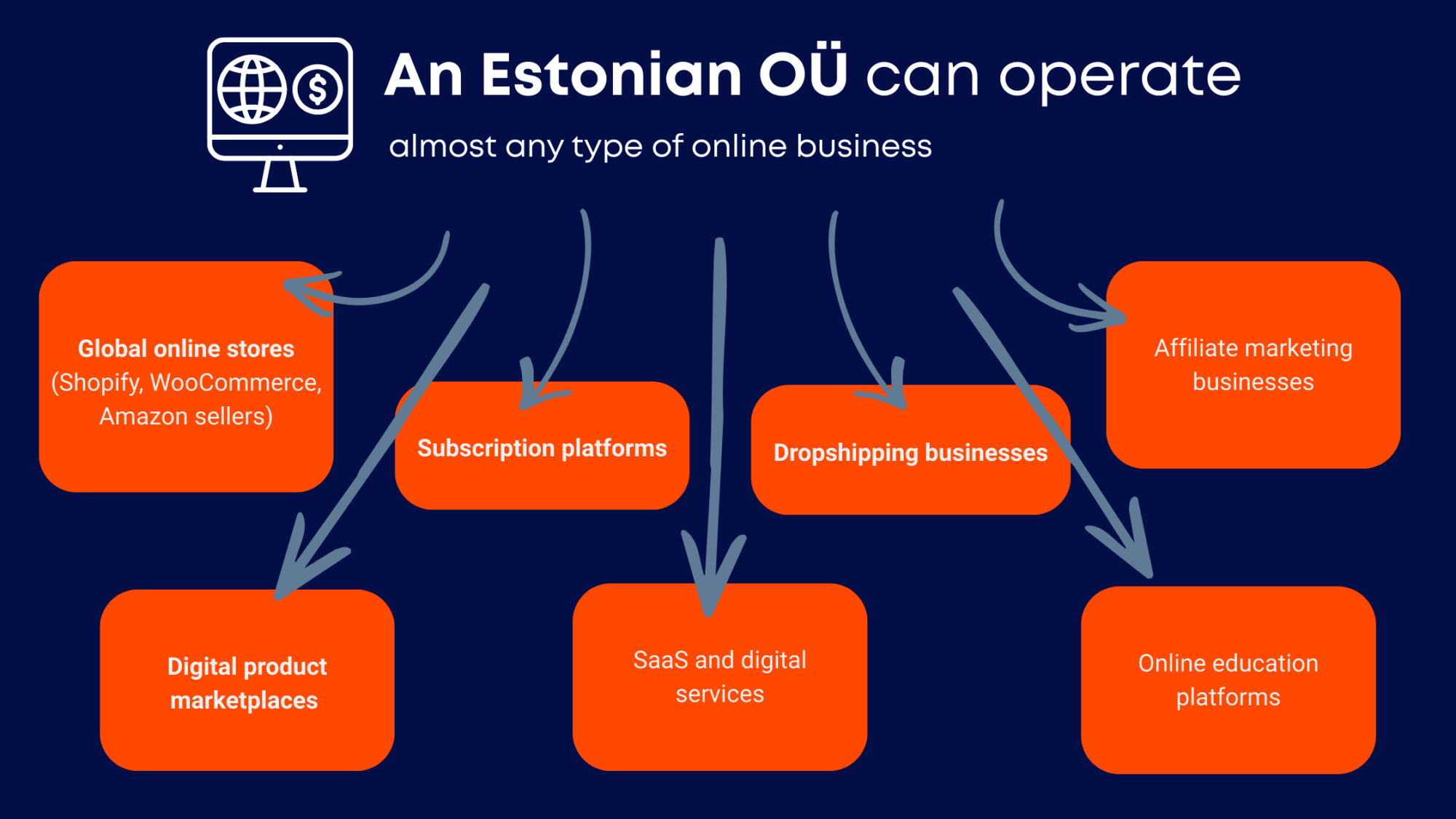
An Estonian OÜ can operate almost any type of online business, including:
- Global online stores (Shopify, WooCommerce, Amazon sellers)
- Digital product marketplaces
- Subscription platforms
- SaaS and digital services
- Dropshipping businesses
- Online education platforms
- Affiliate marketing businesses
The key point is that the Estonian company becomes the legal entity operating the e-commerce activity is managing revenue, contracts, and taxation.
This provides a clear corporate structure for businesses that might otherwise operate in a fragmented way across multiple countries.
Why Many Entrepreneurs Choose E-commerce Estonia
The attraction of E-commerce Estonia is rarely about a single advantage. Instead, it comes from the overall combination of digital administration, EU credibility, and a tax system that supports business growth.
For entrepreneurs who are building scalable online businesses, these structural advantages can simplify operations significantly.
Some of the most important practical benefits include:
- Access to the EU market: An Estonian company is a fully recognized EU legal entity, which simplifies working with European clients, suppliers, and payment providers.
- Digital company management: Most corporate actions are signing documents, filing reports, declaring taxes – can be completed remotely through Estonia’s secure digital systems.
- Clear corporate governance: The legal framework for companies is well-defined and transparent, reducing uncertainty for founders and investors.
- Scalable tax structure: Estonia’s corporate tax model allows companies to reinvest profits without immediate corporate income tax when profits remain within the business.
- Global founder accessibility: Through Estonia’s e-Residency program, non-resident entrepreneurs can establish and manage companies without living in Estonia.
For online businesses operating across multiple jurisdictions, these advantages can significantly reduce administrative complexity.
How the E-commerce Estonia Tax Model Works
One of the most discussed aspects of E-commerce Estonia is the corporate tax system.
Unlike many jurisdictions where corporate tax is charged annually on profits, Estonia follows a distribution-based taxation model.
In simple terms, corporate income tax is only triggered when profits are distributed.
This means that:
• Profits retained within the company and reinvested into business operations are not immediately taxed.
• Corporate income tax applies when dividends or other profit distributions are paid.
• Taxation occurs at the moment profits leave the company rather than when they are earned.
For e-commerce businesses that reinvest profits into marketing, inventory, or technology, this model can provide additional flexibility.
However, entrepreneurs must still maintain proper accounting records and ensure all distributions are declared correctly through Estonia’s tax reporting system.
Payment Systems and Banking for E-commerce Estonia
Running a successful online business requires reliable payment infrastructure.
In the context of E-commerce Estonia, entrepreneurs typically combine several financial tools to manage transactions.
These may include:
• EU fintech banking providers
• Payment gateways such as Stripe or PayPal
• Merchant accounts for card payments
• Multi-currency business accounts
Because the company is an EU entity, many international payment providers are more comfortable onboarding Estonian companies compared with businesses registered in less transparent jurisdictions.
However, onboarding requirements still apply, and entrepreneurs must be prepared to provide documentation regarding their business activity.

Compliance and Accounting for E-commerce Estonia
Although Estonia is known for digital efficiency, running an E-commerce Estonia structure still requires proper compliance.
Every Estonian company must maintain accounting records and submit annual reports.
For e-commerce businesses, accounting typically involves tracking several types of transactions:
- Online platform revenue
- Payment processor settlements
- VAT obligations for EU sales
- International supplier payments
- Marketing and operational expenses
The accounting system must accurately reflect the company’s financial activity and ensure that tax declarations are submitted on time.
Estonia’s reporting system is generally predictable and standardized, which allows entrepreneurs to maintain compliance without excessive administrative burden.
VAT Considerations for Online Businesses
Another important part of E-commerce Estonia involves VAT rules.
For businesses selling goods or digital services within the European Union, VAT obligations may arise depending on the type of product and where customers are located.
For example:
• Digital services may fall under EU VAT OSS reporting.
• Physical goods sold to EU consumers may require distance selling compliance.
• B2B transactions within the EU often follow reverse charge mechanisms.
Because VAT rules can vary depending on the specific business model, e-commerce founders should carefully review their structure before scaling across EU markets.
Proper VAT management helps avoid reporting mistakes and ensures long-term compliance.
The Role of Economic Substance in E-commerce Estonia
As online businesses become more global, regulators increasingly focus on whether companies have genuine local business activity.
In the context of E-commerce Estonia, this means ensuring that the company reflects real operations in Estonia rather than existing only as a registration.
Substance may include:
- Management Board operations held in Estonia (signing of contracts and decisions)
- Registered local office
- Local employees or contractors
- Estonian accounting firm ensuring proper records and reporting
- Estonian business bank account
For many online businesses, substance is naturally created through operational activity – selling products, signing contracts, and managing transactions.
However, it is important to structure the company correctly from the beginning to avoid future compliance risks.
How Silva Hunt Supports E-commerce Businesses
Building an E-commerce Estonia structure involves several interconnected steps are company formation, compliance setup, accounting, and tax strategy.
At Silva Hunt, an Estonia-based accountancy and tax advisory firm, our legal and financial specialists work with international entrepreneurs who want to establish or optimize their online business structures in Estonia.
Our approach focuses on clarity and practical solutions.
Instead of offering generic templates, our team evaluates each case individually, whether the entrepreneur is launching a first online store or restructuring a growing international e-commerce operation.
Silva Hunt supports founders throughout the process:
• Establishing an Estonian company suitable for e-commerce activity
• Structuring accounting and compliance systems
• Clarifying VAT and cross-border tax questions
• Ensuring the company maintains proper legal and financial documentation
• Providing long-term support as the business grows
Entrepreneurs who want to explore the practical steps of setting up an Estonian company can review the available services.
The Strategic Perspective on E-commerce Estonia
The success of E-commerce Estonia is not the result of aggressive marketing or tax loopholes.
It comes from something more sustainable: a regulatory system designed for digital businesses.
Entrepreneurs operating online stores or digital platforms often discover that Estonia provides a predictable environment where companies can grow without unnecessary administrative barriers.
For founders building international businesses, that stability is often more valuable than short-term advantages.
And as global e-commerce continues to expand, Estonia remains one of the jurisdictions where digital entrepreneurs can build structures designed for the realities of modern online business.