Estonia Withholding Tax: Rates, Rules and Key Exceptions

Estonia withholding tax applies to certain payments made by Estonian payers, including some payments to non-residents. The rate and whether tax applies depend on what the payment is for, where the work or service takes place, the recipient’s status and any available exemption or tax treaty. For e-resident businesses, it is especially important to distinguish a management board fee from an employee’s salary and a royalty from an ordinary service or software payment.
What Estonia withholding tax means
Withholding tax is income tax collected by the payer when making a payment. The payer deducts the applicable amount, reports the payment and transfers the tax to the Estonian Tax and Customs Board (EMTA). The rules apply to Estonian companies and other persons acting as withholding agents when they make specified taxable payments.
A non-resident is generally liable to Estonian income tax on income from Estonian sources. In many cases, when tax is correctly withheld, it is the final Estonian income tax on that payment. However, a non-resident may need to file a return for certain income, including business income or gains from transferring property. The exact obligations depend on the income type and whether the recipient has a permanent establishment in Estonia. See EMTA’s overview of non-resident income.
Withholding is triggered by particular payment types. The payer is responsible for applying the correct treatment. A recipient’s non-resident status alone does not decide whether tax is due.
When income paid to non-residents is taxable in Estonia
For employment remuneration, the place where the employee performs the work is generally important. EMTA states that when a non-resident works outside Estonia, the remuneration is not subject to Estonian income tax and is not declared in Estonia, subject to the applicable circumstances and international rules. Where a non-resident works in Estonia for an Estonian employer, the remuneration is taxable in Estonia even if the person spends only a short time working in the country.
Management board remuneration follows a separate rule. A non-resident’s remuneration for serving on the management or controlling body of an Estonian resident company is taxable in Estonia regardless of where the board duties are performed. This means that carrying out board work remotely from another country does not, by itself, remove the Estonian income tax obligation. Tax treaties may also need to be reviewed for the individual case.
Service fees paid to a non-resident legal person are generally subject to Estonian withholding when the service is provided in Estonia. A service carried out entirely outside Estonia will generally fall outside that domestic source rule. An important exception applies to a legal person in a non-cooperative jurisdiction for tax purposes: payments for services to such a person are subject to 22% withholding regardless of where the service is provided or used. Check EMTA’s income from employment guidance e non-resident business income guidance for the relevant distinctions.
Employee salary and board remuneration are not interchangeable categories. For ordinary employment, where the work is done matters. Board remuneration from an Estonian company may be taxable even when the board member works abroad.
Estonia withholding tax rates by payment type
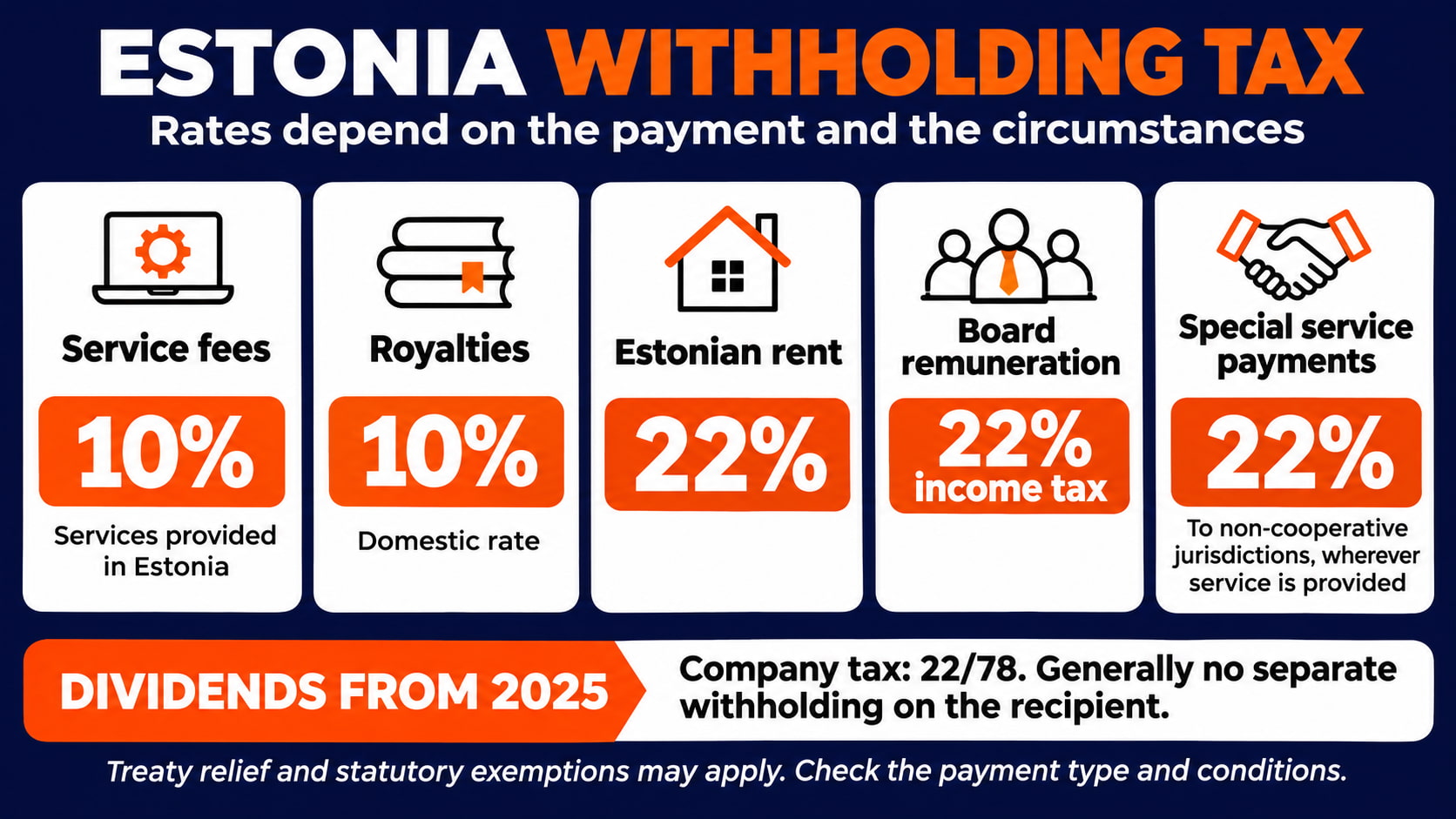
There is no single withholding rate for every payment. The domestic rates below apply subject to the particular statutory conditions, exemptions and any available treaty relief.
| Payment type | General domestic treatment |
|---|---|
| Salary and management board remuneration taxable in Estonia | 22% income tax withholding |
| Service fee to a non-resident legal person for services provided in Estonia | 10% |
| Service fee to a legal person in a non-cooperative jurisdiction | 22%, regardless of where the service is provided or used |
| Royalty paid to a non-resident | 10%, subject to exemptions or treaty relief |
| Rent from Estonian immovable property or certain registered assets | 22% |
| Non-resident entertainer or athlete’s performance fee for a performance in Estonia | 10%, unless a more favourable treaty rule applies |
The 10% rate for royalties is not the general 22% rate. Likewise, the 10% rate for a service fee to a non-resident legal person is tied to the relevant business income rules and should not be applied automatically to all service suppliers. EMTA’s current non-resident taxation information sets out these rates and conditions.
Classify each payment before applying a rate. Royalties generally carry a 10% domestic withholding rate. The 22% rate applies to specific categories and exceptions, not to every payment to a foreign recipient.
Consultazione gratuita
Costruire una base più credibile per il business internazionale
Crea una struttura professionale estone con indirizzo legale, persona di contatto, contabilità, reportistica e consulenza per aiutare la tua azienda a lavorare con banche, partner, investitori e autorità pubbliche.

How royalties, board fees and dividends are treated
A royalty can arise when a payment grants the right to use certain intellectual property, equipment or know-how. But a software subscription is not automatically a royalty. EMTA says the classification depends on the rights transferred; ordinary use of software as a product or service will usually not amount to using the copyright.
There is also a domestic exemption for qualifying royalties paid to an associated company resident in an EU Member State or Switzerland, or to its qualifying permanent establishment in the EU or Switzerland. The payer and recipient must have been connected for a continuous period of at least two years, with at least 25% participation in share capital. The exemption does not cover the portion of a royalty above the value of a comparable transaction between independent parties. This exemption is separate from tax treaty relief.
Dividends have a different treatment. From 2025, Estonian companies generally pay corporate income tax at 22/78 when distributing profit, and non-resident shareholders generally do not pay a separate Estonian withholding tax on those dividends. The transition rule applies when an individual receives a dividend from an unused balance of dividends that was taxed at the former 14/86 rate by 31 December 2024. In that situation, the company generally withholds 7% from the individual’s dividend. For a non-resident individual, a tax treaty may reduce this withholding to 5% or 0%, where the requirements are met. EMTA sets out the dividend transition rules.
Confirm whether a payment grants intellectual property rights. Check the associated-company exemption conditions before relying on it. For dividends, distinguish the company’s distribution tax from the individual’s transitional withholding.
How to report and manage the tax
Estonian companies generally report taxable payments subject to withholding on form TSD. The return and tax are due by the 10th day of the month following the month in which payment was made. Payments to non-residents are commonly reported in Annex 2, while dividend declarations use the relevant dividend reporting forms and annexes. A valid treaty certificate may affect the rate, but a payment may still need to be declared even when the certificate reduces the tax due to zero. Consult EMTA’s tax treaty information e withholding and reporting guidance.
Before paying a non-resident, a company should:
- Identify the recipient’s legal form and tax residence.
- Review the contract to determine whether the payment is salary, board remuneration, a service fee, rent, a royalty or a dividend.
- Confirm where the work or service is performed and whether a specific exception applies.
- Check domestic exemptions and the relevant tax treaty, including the required residence certificate.
- Calculate and report the payment in the correct TSD annex by the deadline, and retain the supporting documents.
Estonia withholding tax cannot be determined from an invoice or the recipient’s address alone. Correct treatment depends on the legal and commercial substance of the payment. When a payment could fall into more than one category, we recommend reviewing the agreement and supporting documents before making the payment.
Keep residence certificates and contracts with the accounting records. Use the right payment category and TSD annex. Resolve classification questions before payment whenever possible.
Written by Dariia Khimichenko, marketing manager.