Estonian Investment Fund: How to Establish One in 2026

An Estonian investment fund allows investors to pool capital and invest according to a defined investment strategy. Estonia offers several legal structures, including alternative investment funds and limited partnership funds. However, establishing a fund requires more than registering a company. Entrepreneurs must understand the relevant licensing requirements, minimum capital rules and restrictions on attracting investors.
In this guide, we explain how investment funds operate in Estonia, which structures are available and what entrepreneurs should consider before establishing one.
What Is an Estonian Investment Fund?
An Estonian investment fund is a legal person or pool of assets that collects capital from several investors and invests it according to a defined investment policy for their common benefit.
Under Estonia’s Investment Funds Act, a fund generally has a fund manager responsible for managing its activities, unless the law provides otherwise.
A fund typically involves three important elements:
- Investors: Individuals or legal entities contributing capital to the fund.
- Investment policy: The strategy defining how the pooled capital will be invested.
- Fund management: The activity of managing investments and other fund operations.
An investment fund differs from an ordinary holding company. A holding company may own investments or subsidiaries, but this does not automatically make it a regulated investment fund.
The actual business model, capital-raising arrangements and investment activities determine which legal requirements apply.
Types of Investment Funds in Estonia
Estonian legislation recognises several categories of investment funds. The appropriate type depends on the investment strategy, intended investors and regulatory requirements.
According to the Estonian Financial Supervision Authority (Finantsinspektsioon), the principal categories include:
- UCITS (euro funds): Regulated collective investment funds operating within the European UCITS framework.
- Alternative Investment Funds (AIFs): Funds that do not qualify as UCITS and fall within the alternative investment fund framework.
- Mandatory pension funds: Funds operating within Estonia’s statutory funded pension system.
- Voluntary pension funds: Funds operating within the voluntary pension savings system.
For entrepreneurs considering private investment structures, alternative investment funds are often particularly relevant.
However, a fund’s legal classification depends on its actual characteristics and activities, not simply the name selected by its founders.
Choosing the Right Legal Structure
Estonian legislation allows investment funds to operate through different legal structures.
One option is a contractual fund, which operates as a pool of assets rather than a separate company.
Another is a public limited fund, established in the corporate form permitted by the Investment Funds Act.
A third option is a limited partnership fund, known in Estonian as usaldusfond. This structure is particularly relevant for certain private investment arrangements.
Under § 8 of the Investment Funds Act, a limited partnership fund may manage its own assets through an eligible general partner or enter into a management contract with a qualifying fund manager.
The partnership agreement regulates important matters, including:
- Partner contributions and participation in the fund.
- Investment policy and permitted investment activities.
- Rights and obligations of the partners.
- Distribution arrangements and fund administration.
An important restriction applies to limited partnership funds: their units cannot be publicly offered, even when the fund manager holds a full operating licence.
Under § 10(3) of the Investment Funds Act, this restriction applies to the fund structure itself.
A limited partnership fund is therefore suitable only where the intended fundraising arrangements comply with the rules on non-public offerings.
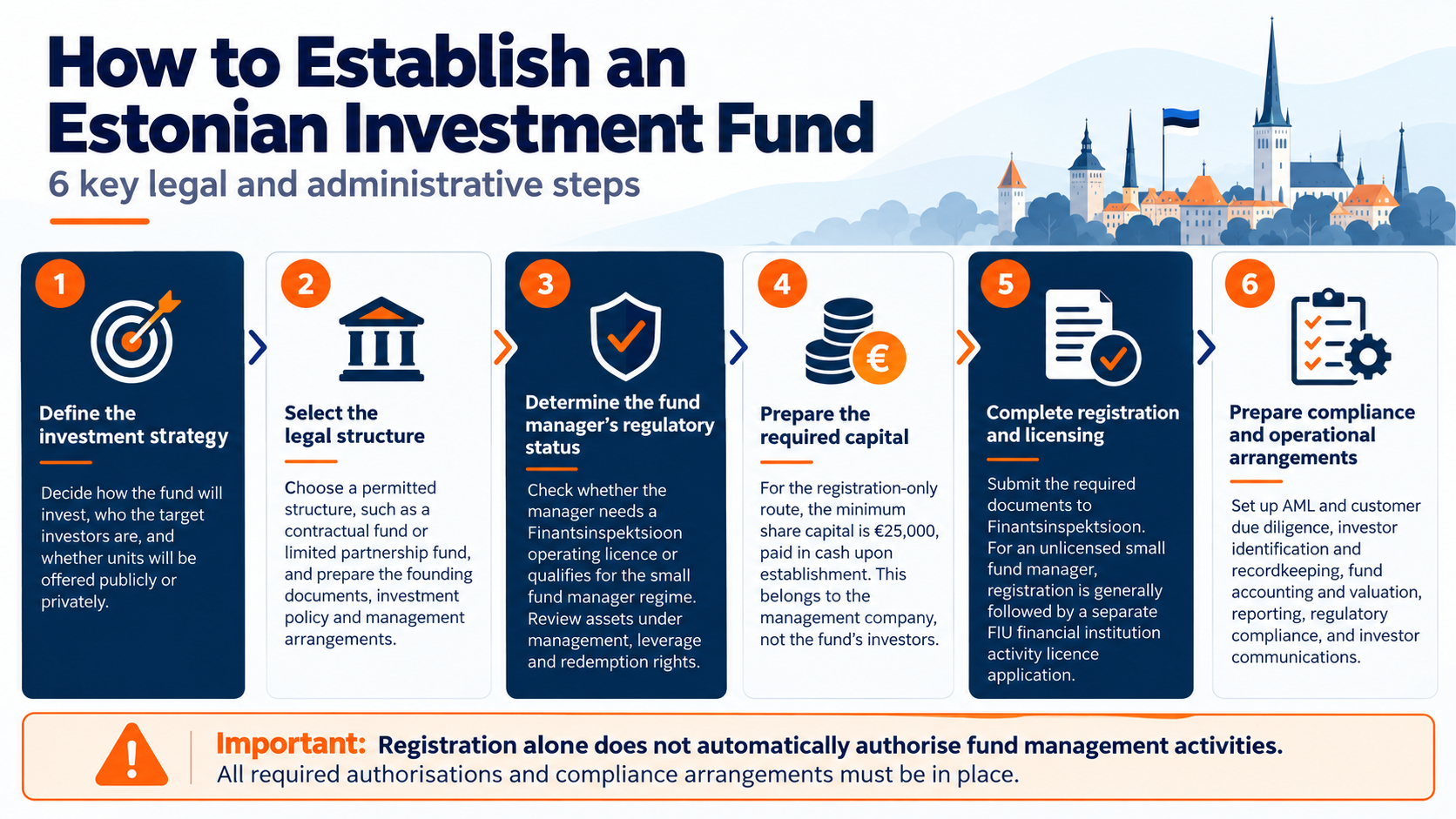
How to Establish an Estonian Investment Fund
Establishing an Estonian investment fund requires several legal and administrative steps. The exact procedure depends on the fund’s structure, investment strategy and management arrangements.
Step 1. Define the investment strategy
Determine how the fund will invest capital, which investors it will target and whether its units will be offered publicly or privately.
These decisions influence the fund’s regulatory classification.
Step 2. Select the legal structure
Choose a legally permitted structure, such as a contractual fund or limited partnership fund.
Prepare the appropriate founding documents, investment policy and management arrangements.
Step 3. Determine the fund manager’s regulatory status
Establish whether the manager requires an operating licence from Finantsinspektsioon or qualifies for the small fund manager regime.
The assessment must consider the total assets under management, use of leverage and investors’ redemption rights.
Step 4. Prepare the required capital
For a small fund manager using the registration-only route, the statutory minimum share capital is €25,000, paid in cash upon establishment.
This is capital belonging to the management company, not money invested by the fund’s investors.
Step 5. Complete registration and licensing
Submit the necessary documentation to Finantsinspektsioon.
Where the manager uses the unlicensed small fund manager regime, registration with Finantsinspektsioon is generally followed by a separate application for a financial institution activity licence from the Estonian Financial Intelligence Unit (FIU).
Step 6. Prepare compliance and operational arrangements
Before commencing activities, establish the applicable procedures for:
- Anti-money laundering (AML) and customer due diligence.
- Investor identification and recordkeeping.
- Fund accounting and valuation.
- Reporting and regulatory compliance.
- Investor communications and fundraising restrictions.
Registration alone does not necessarily authorise the commencement of fund management activities. All applicable authorisations and compliance arrangements must be addressed.
Fund Manager Licensing and Registration
An important part of establishing an Estonian investment fund is determining which licensing and registration requirements apply to its manager.
Estonian law distinguishes between licensed fund managers, licensed small fund managers and registered small fund managers without a Finantsinspektsioon operating licence.
Small fund manager eligibility thresholds
Under § 3(6) of the Investment Funds Act, the small fund manager regime applies where the relevant aggregate assets under management do not exceed:
| Fund management conditions | Maximum aggregate assets |
|---|---|
| Funds including assets acquired through leverage | €100 million |
| Unleveraged fund portfolios where redemption rights cannot be exercised within the prescribed five-year period | €500 million |
These limits apply to the relevant assets managed directly or indirectly, including management through linked companies where the statutory conditions apply.
They are not separate allowances for each individual fund.
A manager must therefore review the total portfolio under management before determining whether it qualifies for the small fund manager regime.
Minimum share capital requirements
Under § 453¹(1) of the Investment Funds Act, a registered small fund manager must have at least €25,000 in share capital, paid in cash upon establishment.
This requirement is separate from the capital contributed by investors to the investment fund.
It applies to the management company and must be considered when planning establishment costs.
The applicable capital and authorisation requirements may differ for managers operating under other licensing regimes.
Finantsinspektsioon and FIU authorisation
A small fund manager may apply for an operating licence from Finantsinspektsioon or, where eligible, register its activities without obtaining that licence.
However, registration without a Finantsinspektsioon licence does not mean that no other authorisation is required.
According to the Estonian Financial Intelligence Unit (Rahapesu Andmebüroo), a registered, unlicensed small fund manager generally must also obtain a financial institution activity licence from the FIU.
The usual order is:
- Register the small fund manager’s activities with Finantsinspektsioon.
- Apply for the relevant financial institution activity licence from the FIU.
- Establish the required AML and compliance procedures before commencing licensed activities.
Il FIU explains that fund managers are considered financial institutions under Estonia’s anti-money laundering legislation.
This involves obligations relating to customer due diligence, risk assessment, monitoring and prevention of money laundering and terrorist financing.
Finantsinspektsioon’s supervision of registered, unlicensed small fund managers is limited to registration and information-submission obligations. This differs from supervision of fully licensed managers.
Since 18 March 2026, fund manager operating licence applications must be submitted through Finantsinspektsioon’s application portal. Registration applications for unlicensed small fund managers continue to be submitted by digitally signed email.
Consultazione gratuita
Mantieni la conformità della tua azienda estone mentre cresce
Tieni sotto controllo la contabilità, i calcoli dell'IVA, l'impostazione degli stipendi, i rapporti annuali, i requisiti di indirizzo legale e le domande di carattere fiscale con un'assistenza continua e personalizzata in base all'attività della tua azienda.

Investment Fund Offering and Advertising Restrictions
Estonian investment funds are subject to rules governing how fund units or shares may be offered to investors.
For a limited partnership fund, § 10(3) of the Investment Funds Act prohibits public offerings of fund units.
Whether an offering qualifies as non-public depends on the legal conditions in § 10(4). Calling an offer private does not automatically make it non-public.
The actual offering arrangements must satisfy the applicable statutory requirements.
There are also specific advertising obligations for registered small fund managers.
Under § 453¹(3) of the Investment Funds Act, advertising must disclose:
- Registration-only status: The manager is registered with Finantsinspektsioon.
- Absence of a fund manager licence: The manager does not hold a fund manager or small fund manager operating licence from Finantsinspektsioon.
- Absence of Finantsinspektsioon supervision: The manager is not subject to Finantsinspektsioon’s prudential supervision as a licensed fund manager.
These disclosures help investors understand the manager’s actual regulatory position.
Before publishing investment advertisements or approaching potential investors, the manager should verify that both the offering method and its communications satisfy the applicable requirements.
Cross-Border Fundraising and EU Regulations
An Estonian investment fund may attract interest from investors outside Estonia. However, international fundraising introduces additional legal considerations.
Registration as a small fund manager in Estonia does not automatically provide the right to market investment funds throughout the European Union.
Under the Alternative Investment Fund Managers Directive (AIFMD), registered managers operating under the sub-threshold regime do not receive the standard EU-wide AIFMD passport merely through registration.
The European Securities and Markets Authority (ESMA) confirms this distinction in its guidance on registered alternative investment fund managers.
Before contacting investors in another country, the manager must examine:
- Local marketing rules: Requirements in the country where investors are located.
- Investor classification: Whether the intended investors qualify as professional investors or fall within another permitted category.
- Notification or authorisation requirements: Whether national rules permit the intended fundraising activities.
- Applicable EU regimes: Whether a separate framework, such as EuVECA where eligible, may provide an appropriate route.
The same principle applies to preliminary marketing communications. National rules may regulate activity before a formal offer takes place.
For international entrepreneurs, cross-border fundraising should be assessed before launching an investment campaign, rather than after potential investors have been approached.
Legal Responsibilities and Investor Protection
An Estonian investment fund must operate within the legal requirements applicable to its structure and regulatory classification.
Fund management involves more than selecting investments. The Investment Funds Act establishes responsibilities relating to:
- Investment management: Implementing the fund’s investment policy and making investment decisions.
- Accounting and valuation: Maintaining fund asset records and preparing financial information.
- Investor administration: Managing fund units or shares and providing required information to investors.
- Compliance and reporting: Fulfilling the obligations applicable to the manager and fund.
Depending on the structure, additional requirements may apply to the safekeeping of assets, auditing and reporting.
Investor protection also differs between licensed and registered-only fund managers. Registration with Finantsinspektsioon does not provide the same level of supervisory oversight as an operating licence.
We should therefore assess the fund’s operational responsibilities, investor-related obligations and regulatory requirements before launching its activities.

Can E-Residents Establish an Estonian Investment Fund?
Estonia’s e-Residency programme provides digital identification tools that support online business administration.
For an entrepreneur considering an Estonian investment fund, the main questions concern the fund’s legal structure, management arrangements and regulatory status.
Holding an Estonian e-Residency digital ID does not itself authorise someone to manage a regulated investment fund.
Similarly, registering an Estonian company is not sufficient to satisfy the requirements of the Investment Funds Act.
International entrepreneurs must also consider the regulatory implications of their activities outside Estonia. This is particularly important when the fund intends to attract investors from other EU countries.
We should therefore assess the proposed investment model before selecting the company structure, preparing fund documentation or beginning fundraising.
How Silva Hunt Can Help With Fund Establishment
Establishing an investment structure requires careful planning, particularly when several investors, different jurisdictions or complex ownership arrangements are involved.
At Silva Hunt, we support international entrepreneurs with Estonian company structures, legal and compliance matters and accounting arrangements.
When considering a fund-related structure, we can help entrepreneurs review their proposed business model, discuss suitable corporate arrangements and identify matters requiring specialist regulatory assessment.
The appropriate approach depends on the investment strategy, management structure and regulatory obligations.
Fund management licensing and registration remain subject to the applicable legal procedures and decisions of the relevant authorities.
If you are considering establishing an investment fund or another investment structure in Estonia, contact Silva Hunt to discuss your plans with our team.
Final Considerations
An Estonian investment fund can provide a legal framework for collective investment activities. However, the right structure depends on the intended investors, investment strategy and management arrangements.
Before establishing a fund, entrepreneurs should review the applicable licensing requirements, minimum capital obligations and fundraising restrictions.
For registered small fund managers, Finantsinspektsioon registration is only one part of the process. The separate FIU authorisation and relevant AML obligations must also be considered.
International fundraising requires additional attention because Estonian registration does not automatically provide EU-wide marketing rights.
Understanding these requirements early helps entrepreneurs select an appropriate legal structure and prepare for compliant fund operations.
Scritto da Dariia Khimichenko, responsabile marketing presso Silva Hunt.